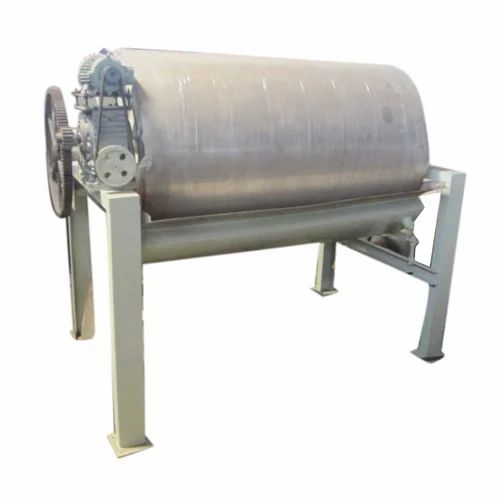
An attritor (also called a stirred media mill) is a high-energy grinding mill used for dispersing pigments and grinding solids into a liquid medium, commonly used in the paint, ink, coating, ceramics, and chemical industries.
Key Features:
Vertical cylindrical tank with a central rotating shaft
Shaft has agitator arms or discs that stir the grinding media (ceramic/steel balls)
Material is poured into the tank, and grinding media break down particles by impact and shear forces
Efficient for high-viscosity mill bases and sub-micron grinding
Parts of an Attritor:
| Component | Description |
|---|---|
| Tank | Usually SS304/316; holds the material and grinding media |
| Shaft + Agitator | Rotates to move grinding media |
| Grinding Media | Ceramic/steel balls used for dispersion and size reduction |
| Motor + Gearbox | Drives the shaft with controlled speed |
| Jacketed Tank (optional) | For cooling/heating to control temperature during grinding |
Advantages of Using an Attritor:
- Faster grinding than conventional ball mills
- Can handle high-viscosity formulations
- Excellent pigment dispersion and fine particle size
- Scalable from lab to industrial production
Used for:
- Water/solvent-based paints
- Acrylic emulsions
- Pigment dispersions
- Inks, adhesives, and more
In paint manufacturing, the attritor is mainly used to grind the mill base, which is then let down to produce the final paint.
SS 304 is generally sufficient for grinding water-based acrylic emulsion paints under the following conditions:
Advantages of SS 304 in this application:
- Corrosion Resistance: SS 304 has good resistance to water-based chemicals, including acrylic emulsions, due to its chromium (18%) and nickel (8%) content.
- Non-reactive Surface: It won’t contaminate the paint or cause discoloration.
- Durability: Suitable for the mechanical wear involved in pigment dispersion.
However, note these practical considerations:
- Avoid high chloride levels in the formulation or cleaning agents, which may cause pitting corrosion in SS 304.
- If your emulsion contains ammonia, strong alkalis, or acidic pH, consider monitoring the system closely or upgrading to SS 316 for better chemical resistance.
- Proper maintenance and cleaning after each batch is important to prolong the vessel life.
Grinding Media
Grinding Media for Attritor Mills
The choice of grinding media in an attritor depends on the type of material, viscosity, grinding fineness required, and chemical compatibility.
Common Grinding Media Types:
| Media Type | Material | Typical Size | Applications / Notes |
|---|---|---|---|
| Ceramic Balls | Zirconia, Alumina | 1–3 mm | High density, chemically inert; best for white & light-colored paints |
| Glass Beads | Soda-lime glass | 0.5–3 mm | Economical, moderate wear resistance; for low-viscosity or soft pigments |
| Steel Balls | Chrome/SS Hardened | 1–5 mm | High density & impact; for heavy pigments, industrial paints, solvent-based systems |
| Striated Ceramic Balls | Zirconia-alumina blend | 2–3 mm | Higher surface area, better shearing; improves pigment wetting and grind speed |
Selection Criteria of :
- Hardness: Must be harder than the pigment particles.
- Chemical Compatibility: No reaction or discoloration with binder or pigment.
- Density: Heavier media = more shear → faster grinding.
- Size: Smaller = finer grind, but lower throughput.
- Shape: Spherical preferred for uniform grinding.
Typical Recommendations for Water-Based Acrylic Emulsion Paints:
- Material: Zirconia or Striated Ceramic
- Size: 2 mm
- Loading: ~50–60% of tank volume filled with media
- Note: Avoid steel if iron contamination or discoloration is a concern.
Charging Grinding Media
For a 100-S attritor with a 600-liter tank capacity, the typical grinding media loading is:
Grinding Media Volume Loading:
- 50–60% of the tank volume is filled with grinding media.
Calculation:
- 50% of 585 L = ~292.5 L
- 60% of 585 L = ~351 L
Practical Range:
- Grinding media required = 290–350 liters by volume
Weight of Grinding Media (Approximate):
Depends on the media density:
| Media Type | Density (g/cm³) | Volume (L) | Weight (kg) Range |
|---|---|---|---|
| Zirconia Ceramic | 5.5–6.0 | 290–350 | 1,595–2,100 kg |
| Steel Balls | 7.8 | 290–350 | 2,260–2,730 kg |
| Glass Beads | 2.5 | 290–350 | 725–875 kg |
Notes:
- Use strainers during discharge to retain media.
- Media must be pre-washed and fully submerged to avoid cavitation and wear.